

Hosting · 6 min read
A corporate tasting people remember.
Start from the objective, not the wine list. Team building, client hospitality and a celebration each call for a different format, but every one needs food, water and a firm finish.
A corporate wine tasting is remembered for the right reasons when it is designed around the people in the room rather than the bottles on the table. Decide what the evening is for, who is coming and how it will end. For most groups that points to six wines over about two hours, with food and water from the first pour and a firm finish. The wine list comes last and almost writes itself.
A common mistake runs the other way: an ambitious list of ten wines, a long talk, canapés that run out early and no plan for the finish. People remember that evening too, though not in the way anyone intended.
Start from the objective and the audience
Write the objective down in one sentence, because each one points to a different evening.
- Team building. The point is conversation between people who rarely talk. Mixed teams, a light competitive edge and a format in which nobody needs prior knowledge to take part.
- Client hospitality. The point is time with the client. A seated format, fewer interruptions, a few remarkable bottles and a host who reads the table. The usual courtesies of wine at a business dinner apply in full.
- A celebration. The point is the occasion. Champagne on arrival, one or two bottles worth talking about and short speeches.
- A learning session. The point is that people leave knowing something useful. One clear theme, a short explanation per wine and time to taste.
Then look honestly at who is coming. Expect a mix: a few keen collectors, many who enjoy wine without studying it and some who do not drink at all, for reasons of health, faith or simple preference. Pitch the evening at the middle of the room, give the enthusiasts one or two bottles to talk about and treat the non-drinkers as full guests.
Choosing a corporate wine tasting format
Three formats cover almost every brief.
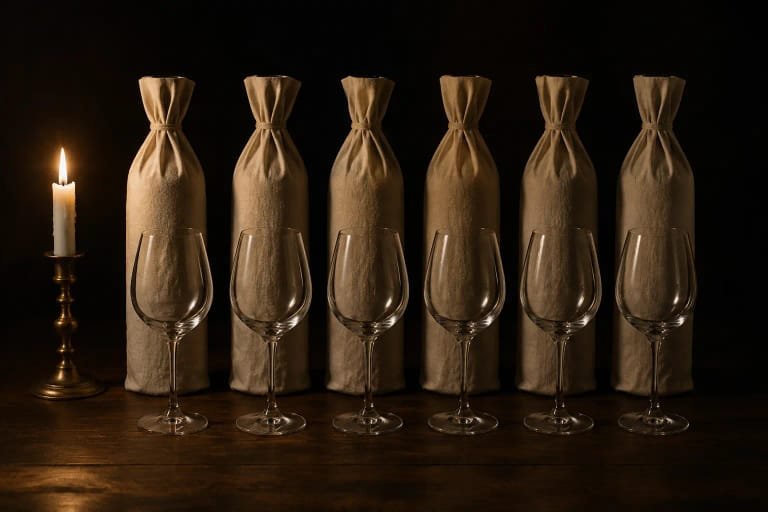
- A blind tasting competition in teams. Bottles are bagged and numbered, teams of four argue over grape, region and age, then the reveal settles it. It suits team building best because hiding the labels levels the room: seniority and famous names count for nothing and the arguments inside each team do the rest.
- A seated dinner with wines matched to courses. The natural choice for clients and celebrations. Conversation stays at the table, the wine arrives with the food and nobody has to juggle a glass and a plate.
- A short masterclass. A focused session around a handful of wines: one region, one grape or simply how to taste. It works as a learning session on its own or as the opening half hour of a dinner. Keep the talking short and the tasting long.
For the blind format, the kit and running order of a blind tasting carry over directly from a private evening, from the bags and scoring sheets to the spittoons. A well-chosen theme turns a guessing game into a lesson. For the dinner, the arithmetic of a wine dinner is the same whether the guests are friends or clients. We run both for companies, from blind tasting evenings to fine dining and vintages dinners.
The room and the kit
Seat people. Standing suits a reception, but a tasting needs space at the table for several glasses, a sheet, a plate and a water glass.
- Group size. One host can hold a room of a dozen or two. Beyond that, split into tables of eight to twelve with someone pouring at each. Otherwise the evening dissolves into queues.
- Light and sound. Colour is part of tasting, so start in good, neutral light; candles can come out with dinner. Choose a room where the host can be heard without shouting and keep music off while anyone is talking.
- The venue. A licensed venue that hosts tastings regularly will have the glassware, the fridge space and staff who know how to pour.
- Glasses and spares. One glass per wine per guest means 180 glasses for six wines and thirty people, a job for the venue or a hire company. Keep a reserve bottle of each wine in case one is corked.
- Temperature. In a warm room the reds need chilling as well as the whites, so plan fridge space and ice buckets around the right serving temperatures.
A host who keeps time is worth more than a famous bottle. Their only job is the running order: when each wine is poured, when the talking stops, when the food arrives.
Timing and pacing
A weekday evening works best, starting soon after work and running about two hours. Six wines is plenty in that time. More wines do not make a better evening, only a blurrier one.
People arrive from the office hungry, so feed them from the first pour. Bread, cheese and cured meat at the least, a sequence of small dishes at best; never a bowl of crisps.
Pour tasting measures. At 50 ml a bottle serves fifteen, so a guest who tastes all six wines has had less than half a bottle across the evening. Keep the talk to two or three minutes per wine, then let the tables talk. Put a jug of water on every table and keep it full. Fix the end time in advance, with a last pour that everyone knows is the last.
Six wines in two hours, with food throughout and water on every table, is all the structure a corporate tasting needs.
Make it work for everyone
A corporate tasting is a work event. Nobody should feel they have to drink to belong.
- Good alcohol-free options. Not just soft drinks: an alcohol-free sparkling wine, a good tea, a pressed juice, served in the same glasses as everything else so nobody stands out.
- Spitting is normal. Put an opaque cup or a spittoon within reach of every guest and explain that professionals spit. It helps if the host or the most senior person in the room does it first.
- No pressure. No toasts that require an empty glass, no top-ups nobody asked for, no remarks about who is not drinking.
- No jargon. If a word needs explaining, explain it. Score teams on their reasoning as well as their answers, so beginners have something to win.
- Dietary needs. Ask about allergies and dietary requirements with the invitation, well before the night.
Getting everyone home safely
Decide how people are getting home before the evening begins. Book cars or taxis in advance for anyone who needs one and make it plain that nobody drives after drinking. End with food instead of one more bottle and keep the water coming until the last guest leaves. Someone from the organising side should stay until then too.
What to measure afterwards
Measure the evening against the sentence you wrote at the start. For team building, did people talk to colleagues they rarely see? For clients, did the conversations continue in the weeks that followed? For a learning session, can people name one thing they now look for in a glass?
Send the list of wines the next morning. It keeps the conversation going and the replies are the simplest measure of interest you will get.
The order of work is short. Write the objective in one sentence, choose the format that serves it and cut the list to six wines. Spend the rest of your planning time on the food, the water and the way home.